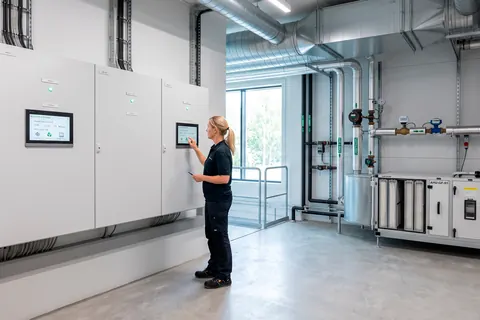

Ask three people what a BMS is and you may get three different answers. Add BAS, BEMS and EMS to the conversation and the confusion grows. The terms overlap, but they are not identical, and the difference matters when you write a scope or compare quotations.
Building management system (BMS)
A BMS monitors and controls the mechanical and electrical services of a building from one platform. In a typical UAE commercial building that means chillers or district cooling interfaces, air handling units, fan coil units, ventilation fans, pumps, lighting circuits and energy meters. It also collects alarms from other systems such as lifts, generators and fire alarm panels.
The key word is management. A BMS gives the facility team one place to see what is running, what has failed and how the building is performing.
Building automation system (BAS)
A BAS is the automation side of the same idea: controllers running control loops and sequences. It opens the chilled water valve to hold the supply air temperature, starts the standby pump when the duty pump trips, and switches lighting on a schedule. Strictly speaking, a BAS can run without a central front end, while a BMS adds the supervision layer on top.
In practice, most consultants in the region use BMS and BAS for the same scope. Read the specification, not the abbreviation.
Energy management system (EMS)
An EMS is focused on energy data rather than control. It collects readings from electricity, chilled water, water and gas meters, normalises them against weather and occupancy, and reports consumption, peaks and costs. Some EMS platforms also control loads, for example shedding non-essential equipment at peak times.
An EMS is especially useful when you run several buildings, need to compare sites, or have to report energy performance for an ISO 50001 energy management system or a regulator.
BEMS: the middle ground
A building energy management system (BEMS) is a BMS with energy features turned up: sub-metering, trend logging, dashboards and reports. For a single building, a well-configured BEMS often removes the need for a separate EMS.
How the systems compare
| System | Main job | Typical users |
|---|---|---|
| BAS | Automatic control of HVAC, lighting and plant | Controls engineers, commissioning teams |
| BMS | Control plus central monitoring, alarms and integration | Facility managers, operators |
| BEMS | BMS with metering, trends and energy reports | Facility and energy managers |
| EMS | Energy data across meters and sites, reporting, targets | Energy managers, finance, sustainability teams |
Which one does your building need?
For most single buildings in Dubai, the answer is a BMS with good metering and trending. That covers comfort, plant protection, alarms and the energy reports the owner needs. Add an EMS when you manage a portfolio, need tariff-level analysis or face formal reporting.
Industrial sites are different. Process equipment is usually controlled by PLC and SCADA systems, and the BMS covers the building services around them. If that is your situation, our article on PLC vs SCADA vs DCS explains the industrial side.
Write the scope around functions, not labels
Whatever the system is called, a clear scope lists the equipment to control, the equipment to monitor, the integrations, the meters, the reports and the users. That is what a contractor prices and what you will receive. If you want help turning a set of drawings into a clear BMS scope, see our BMS contracting service.