PLC, SCADA and DCS often appear together in tender documents for factories, pumping stations and utilities in the UAE. They overlap, but each has a clear role. Knowing the difference helps you write the right scope and avoid paying for a system that does not suit the process.
PLC: the controller in the panel
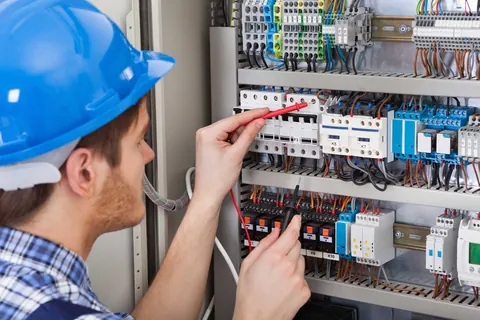
A programmable logic controller is an industrial computer that reads inputs from sensors and switches, runs a program, and drives outputs such as motors, valves and alarms. PLCs are built for harsh environments and fast, reliable logic. A packaging line, a pump set or a water treatment skid usually has its own PLC.
PLCs are programmed in the languages defined by IEC 61131-3, such as ladder diagram, function block diagram and structured text. Major platforms in the region include Siemens, Rockwell Automation, Schneider Electric, Mitsubishi Electric and Omron.
HMI: the local screen
A human-machine interface sits next to the machine or panel. Operators use it to start and stop equipment, change setpoints and see alarms. It talks to one PLC or a small group of PLCs.
SCADA: supervision across a site or many sites
Supervisory control and data acquisition software collects data from many PLCs and remote terminal units, displays it on operator screens, stores history, raises alarms and lets operators send commands. A water utility may monitor dozens of pumping stations from one SCADA control room. A factory may use SCADA to watch every line from a central office.
The key point: SCADA supervises. If the SCADA server stops, the PLCs keep controlling the process.
DCS: one engineered system for continuous processes
A distributed control system combines controllers, operator stations, engineering tools and a historian into one integrated product from one vendor. It is designed for large continuous processes with many interacting control loops, such as refineries, petrochemical plants and power stations. Configuration, alarms and graphics are all managed in one database.
How to choose
| Situation | Usual choice |
|---|---|
| Single machine, skid or pump set | PLC with a local HMI |
| Factory with several lines | PLCs per line plus SCADA |
| Water network or pumping stations spread over an area | PLCs or RTUs at each site plus SCADA with telemetry |
| Large continuous process with tightly linked loops | DCS, often with PLCs for packaged units |
Where VFDs and panels fit
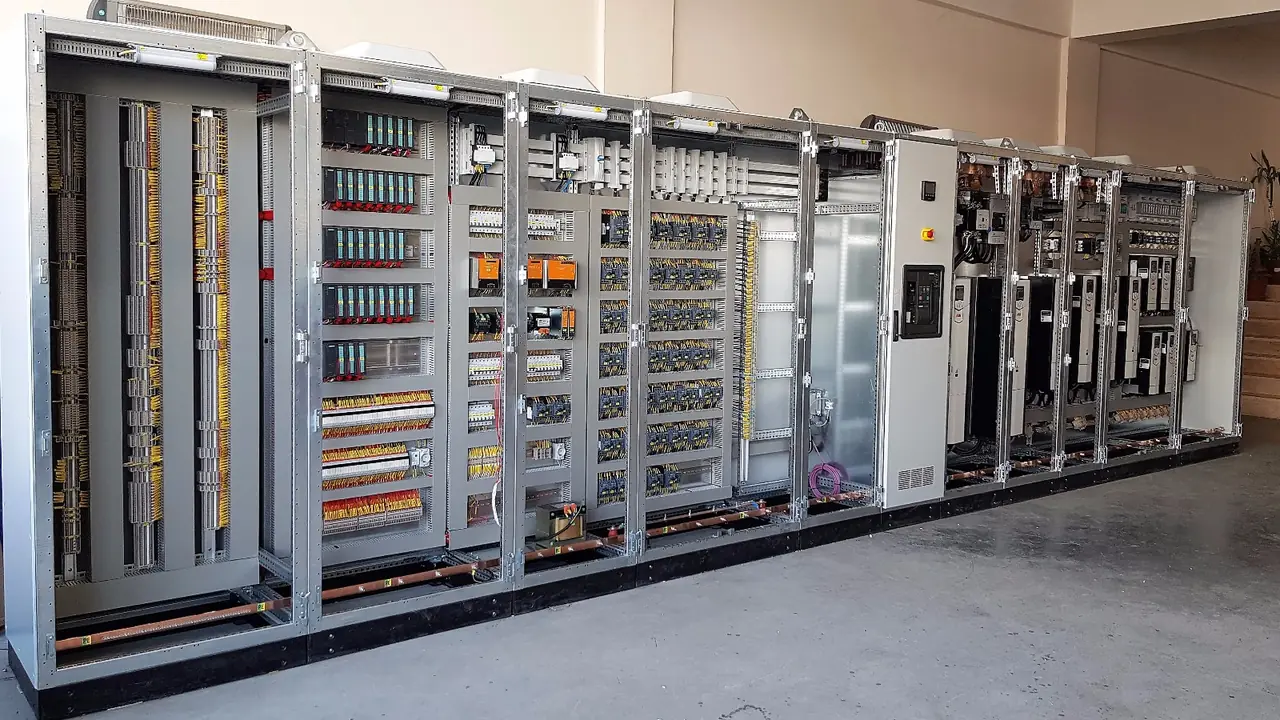
Variable frequency drives control motor speed and are usually commanded by the PLC. Panels house the PLC, drives, protection and wiring. Panel quality matters as much as the program, especially in UAE heat; our guide to control panel design covers that, and VFD selection covers drives.
Upgrading an existing system
Many plants run on controllers that are no longer manufactured. Replacing them needs planning to avoid long shutdowns. Read PLC migration: replacing obsolete controllers for the steps we follow.
Synthronix supplies, programs and commissions PLC, SCADA, HMI and VFD systems and builds new control panels. See our industrial automation service.